Summary Sindh budget 2026-27 announces 7% salary and pension increase, higher minimum wage, major solar rollout, housing expansion, and large-scale Karachi infrastructure projects.
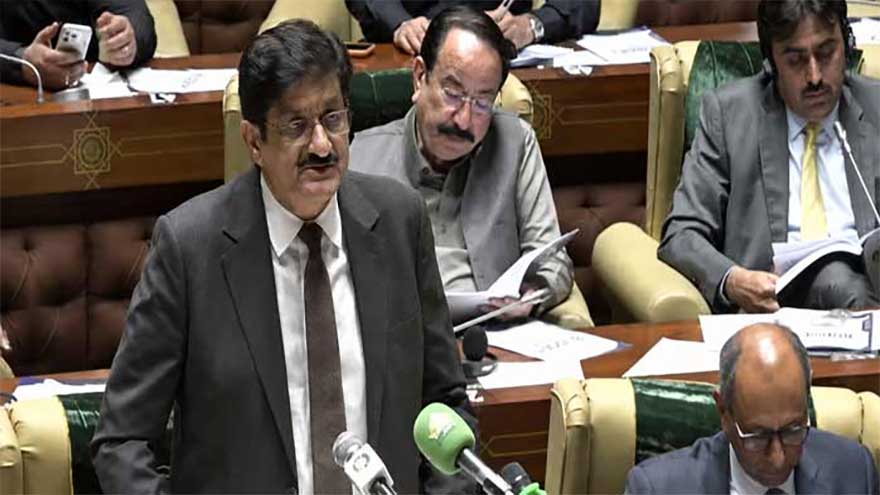
KARACHI (Dunya News) – The Sindh government on Tuesday presented its budget for the fiscal year 2026-27 in the provincial assembly, unveiling a total outlay of Rs3.562 trillion along with a broad package of development initiatives, welfare measures, and economic reforms.
Chief Minister Syed Murad Ali Shah, while presenting the budget, announced that no new taxes have been introduced for the upcoming fiscal year. He said the government’s priority remains providing relief to citizens and supporting the business community amid ongoing economic pressures.
Salaries, pensions and wage relief
A key feature of the budget is a 7 percent increase in salaries and pensions for provincial government employees. The government also announced the merger of ad-hoc relief allowances issued in 2022 and 2025 into basic pay structures, aiming to simplify compensation frameworks.
In addition, the minimum monthly wage has been raised from Rs40,000 to Rs43,000, a move expected to benefit low-income workers across industrial and service sectors in the province.
Financial and economic institutions
The Sindh government announced the establishment of the “Sindh International Financial Centre,” envisioned as a multi-purpose platform for infrastructure finance, Islamic finance, and climate finance. Officials said the centre would be designed to attract domestic and international investment and strengthen Sindh’s role in financial innovation.
The government also reiterated its ambition to transform Keti Bandar into a major maritime, logistics, industrial, and energy hub. The project is planned to be integrated with the Dhabeji Special Economic Zone and the Thar coal resource corridor, creating a linked industrial ecosystem.
Chief Minister Murad Ali Shah described both Port Qasim and Keti Bandar as strategic milestones in Sindh’s long-term economic development, saying the new port initiative would strengthen Pakistan’s trade connectivity with global shipping routes.
Energy transition and solar expansion
One of the largest social and energy initiatives announced is a nationwide solar programme originating from Sindh. Under this scheme, 275,000 free solar home systems will be distributed to low-income households at a cost of Rs18 billion.
Alongside this, the government will introduce a subsidised solar financing scheme for middle-income families to encourage broader adoption of renewable energy and reduce dependence on conventional power sources.
The chief minister said these efforts align with a broader vision to position Sindh as a renewable energy hub within Pakistan.
Digital economy and climate infrastructure
The budget introduces the Sindh Green Data Infrastructure Initiative, aimed at attracting investment in modern data centres and artificial intelligence infrastructure. Officials said the initiative would support climate-friendly digital growth and improve Pakistan’s capacity in emerging technologies.
A “Waste-to-Value” programme was also announced, under which municipal waste will be converted into economic assets, including the generation of carbon credits. The government said the initiative is designed to reduce environmental pollution while creating new revenue streams.
Agriculture and rural development
The provincial government announced a major policy shift for agriculture, including planned legislation to support small farmers through agricultural collectives. These collectives will aim to provide access to machinery, credit facilities, insurance coverage, and modern farming technology to small landholders.
Special emphasis was placed on supporting “haryis” (farmers), with the government stating that climate change and water stress have made agricultural resilience a key priority.
A social protection allocation of Rs13.2 billion was announced, covering programmes such as kitchen gardening initiatives, the Benazir Hari Card, and women-focused agricultural worker support schemes.
Development spending and infrastructure expansion
Sindh reported that over Rs900 billion was spent on development projects in the previous year, reflecting an aggressive infrastructure-led development strategy.
For FY2026-27, the Annual Development Programme (ADP) has been set at Rs400 billion. The largest allocations include Rs121.6 billion for local government and municipal infrastructure, Rs40.9 billion for public health engineering, Rs39.5 billion for transport and communication, Rs30.9 billion for irrigation, Rs25.9 billion for education, Rs17.4 billion for health, and Rs6.3 billion for agriculture and livestock development.
Karachi-focused mega projects
A significant portion of the budget is directed towards Karachi’s infrastructure transformation. Work continues on the Greater Karachi Sewerage Plan (S-III), estimated at over Rs32 billion, along with the Lyari Transformation Package worth Rs5 billion.
The Karachi Traffic Corridor Improvement Programme has been allocated Rs4.17 billion, while Rs5.53 billion has been set aside for rehabilitation of inner-city roads. In central Karachi towns, Rs3.18 billion will be used for road improvements across multiple municipal areas.
The Karachi fire brigade system will also be upgraded with an allocation of Rs7.69 billion.
Public transport expansion
To improve urban mobility, the government approved Rs4.8 billion for the procurement of 50 modern double-decker buses. Of these, 25 buses are expected to begin operations within three months, serving an estimated 30,000 to 35,000 passengers daily.
The Pink Bus Service, designed primarily for women commuters, will be expanded with 28 buses already operational across multiple routes. The government also plans to add 100 more electric buses to Karachi’s transport network.
An automated fare collection system has been introduced across Green Line, Orange Line, and Peoples Bus Service routes.
Safety and law enforcement improvements
Under the Safe City Programme, 1,325 smart surveillance cameras have been installed across Karachi. The system includes facial recognition and number plate identification technology.
Officials reported a 67 percent reduction in vehicle theft and snatching incidents, along with a 54 percent decline in street crime. Crime detection and investigation success rates have reportedly improved to 81 percent.
Housing and post-flood rehabilitation
Under the Sindh Peoples Housing Programme, the government has completed 1 million homes for flood-affected families since 2022. International partners have also committed funding of approximately $1.675 billion for an additional 1.75 million housing units.
The programme has also reportedly empowered women by granting property ownership rights in large numbers of reconstructed homes.
Health sector expansion
Major health institutions including NICVD, SIUT, and JPMC are being expanded under the new budget framework. The government highlighted strengthened telemedicine services and expansion of the 1122 ambulance network.
Officials said these improvements aim to enhance emergency response and specialised healthcare access across urban and rural Sindh.
Education and human development
The government said more than 1,300 schools have been constructed or rehabilitated in recent years, alongside new teacher recruitment drives.
A targeted relief package has also been introduced for education, agriculture, insurance, and employment sectors. Additionally, the sales tax on educational support services has been reduced to 5 percent to ease costs.
Fiscal framework and NFC concerns
Murad Ali Shah said the budget is based on four guiding principles: constitutional rights, fiscal sustainability, national stability, and public welfare.
He noted that coordination with the federal government under the National Finance Commission (NFC) framework led to a reduction in the provincial development portfolio from Rs575 billion to Rs400 billion.
Despite this, the government said it has ensured protection of Sindh’s share under the NFC Award.